Skip to content
By Rabecca Mwila
The 100-Metre Race You Didn’t Enter
Imagine two raindrops falling side by side on a hillside maize field. One lands between rows that run straight up and down the slope. The other lands on a field where rows follow the contour, gently curving across the hill.
The first raindrop joins a fast-moving stream of runoff. Within minutes, it reaches the bottom of the field, carrying loose soil with it. That soil, your topsoil ends up in the river, then the dam, then the ocean.
The second raindrop hits a ridge or a grass strip. It slows down, pools and then slowly sinks into the ground. It waters the roots of your crops. It stays on your land.
That is the power of contour farming. It is not complicated nor expensive. It’s simply choosing to farm across the slope instead of up and down.
This article explains what contour farming is, why it works and how you can start using it on your farm without any special equipment.
Why “Farming Straight” Is Destroying Your Soil
Most farmers, when they first clear a slope, they plant in straight rows running from the top of the field to the bottom. Naturally, they follow the easiest path with your oxen or tractor. They want straight lines because they look neat.
However, those straight rows are water highways.
Across the slope (on the contour)Water hits each ridge or plant stem and slows down.
| Planting Direction | What Happens When It Rains | ||||||||||
| Up-and-down (with the slope) | Water runs straight between the rows. It gains speed, picks up soil and carves gullies. | ||||||||||
| It sinks in instead of running off. |
The damage from straight-row farming on slopes:
- Gullies – deep channels that grow larger every season, eventually making the field unplantable.
- Topsoil loss – the richest layer of your soil washes away first.
- Fertiliser waste – expensive inputs flow off your land before crops can use them.
- Lower yields – thinner soil and less water mean weaker plants.
The hidden cost: You spend more each year on fertiliser and repairs, but your land gets worse. You are fighting gravity and gravity always wins.
What Contourless Farming Looks Like in Five Years
Let’s visit a farm that has farmed up-and-down for five seasons.
The top of the field is now rocky and as the topsoil has washed down to the bottom. At the bottom, the soil is piled deep, waterlogged and difficult to plough. In between, three deep gullies cut across the field like open wounds. Each rainy season, they get wider and deeper.
The farmer spends weeks each year filling gullies with stones and branches, only to watch them wash out again. His yields are half what they used to be. He is thinking of abandoning the field.
Now visit a farm on the same slope that switched to contour farming five years ago.
The field is a series of gentle, level steps. Behind each grass strip or stone line, rich, dark sediment has built up topsoil that would have been lost, now captured. The farmer plants maize in the wide strips between contours. Water soaks in where it falls. His yields have increased every year.
The difference is not luck. It’s contour farming.
Solution (How Contour Farming Works – How to Start)
Contour farming is simply planting across the slope, following the natural level lines of the land. Those level lines are called contours, imaginary lines where every point is the same height above sea level.
When you plant along a contour, each row acts as a tiny dam. Water running downhill hits the row and slows down. Soil particles settle out and water sinks in.
Step 1: Find the Contour Lines (Using an A-Frame)
You cannot guess where the contours are. You need a simple tool: the A-frame.
Quick reminder:
- Build an A-frame from three poles.
- Calibrate it so the hanging string marks the centre of the crossbar.
- Walk across your slope, pivoting the A-frame and stake out points where the string hangs over the centre mark.
- Connect the stakes – that’s your contour line.
How many contour lines do you need?
| Slope | Spacing Between Contour Lines |
| Gentle (less than 5%) | 15-20 metres |
| Moderate (5-10%) | 10-15 metres |
| Steep (10-20%) | 5-10 metres |
For most smallholder fields, 3-5 contour lines will transform the farm.
Step 2: Mark the Contours Permanently
Once you have staked out your contour lines, make them visible. You can:
- Plant a grass strip (vetiver, Napier) along the line.
- Build a low stone line.
- Dig a shallow ditch (contour ditch).
These permanent markers also act as erosion barriers. They do double duty by showing you where to plant and they protecting your soil.
Step 3: Plant Your Crops Along the Contours
Now comes the change. Instead of ploughing straight up-and-down, you will plough parallel to your contour lines.
For hand-hoe farmers:
Walk along your contour line, digging planting holes in a row that follows the curve. When you finish one row, move upslope about 60-90 cm and plant the next row also parallel to the contour.
For ox or tractor farmers:
Mark your contour lines clearly then plough in strips between them, always staying parallel to the lines. This may feel strange at first because your rows will curve gently across the slope but the results are worth it.
Step 4: Maintain Your Contour System
Contour farming is not a one-time job. You need to:
- Inspect after heavy rains – repair any breaks in grass strips or stone lines.
- Keep grass strips cut – don’t let them become overgrown or harbour pests. Use the grass for mulch or fodder.
- Re-stake every few years – contours never change, but your stakes may rot. Check your lines annually.
What If Your Slope Is Very Steep?
On steep slopes (over 15%), contour farming alone may not be enough. You need terracing but that’s a bigger job. Start with:
- Closer contour spacing – 3-5 metres apart.
- Stronger barriers – stone lines or deep contour ditches.
- Cover crops – keep the soil covered year-round.
- Perennial crops – plant trees or shrubs that hold soil with deep roots.
Even on very steep land, contour farming reduces erosion dramatically compared to straight-row planting.
Download the KATC Soil and Water Conservation Poster for more details.
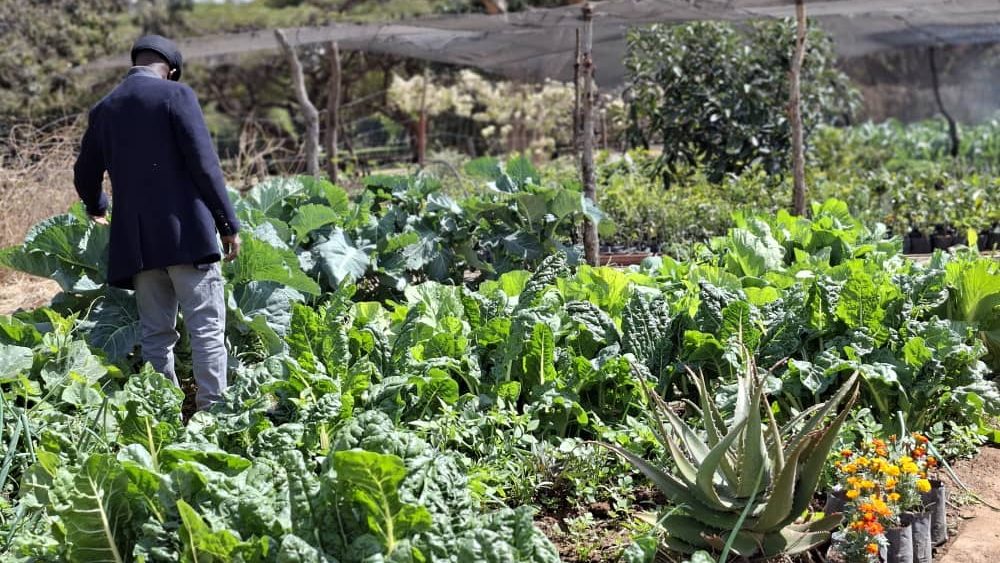
Image Caption: Rainwater harvested and conserved to support a thriving organic vegetable garden at PELUM Zambia.
Credit: PELUM Zambia