Skip to content

By Rabecca Mwila
Why Saving Water Is Becoming More Important Than Ever
For generations, farmers have depended on rainfall to grow food, feed livestock and support their families.
However, many farmers now are noticing a troubling pattern. The rains are becoming less predictable.
Some seasons’ rains begin late while others end too early. In some areas, heavy downpours are followed by long dry spells. As a result, water is becoming one of the most valuable resources on the farm.
Yet while many farmers worry about the amount of rainfall they receive, another important question is often overlooked:
How much of that water actually stays on the farm?
The truth is that a significant portion of rainfall is often lost through runoff, evaporation, poor soil management and erosion.
In a time of increasing climate uncertainty, learning how to keep more water in the field could be the difference between a successful harvest and a disappointing one.
The Hidden Ways Farms Lose Water
When rain falls, not all of it reaches crop roots.
Some water evaporates from bare soil before plants can use it.
Some runs off the field, carrying away valuable topsoil and nutrients.
Some is lost because compacted soils prevent water from soaking into the ground.
The result is that farmers may receive enough rainfall during a season but still experience water shortages when crops need moisture most.
This challenge becomes even greater during periods of drought or extreme heat.
When soils cannot capture and retain water effectively, crops become more vulnerable to stress, yields decline, and farming becomes increasingly risky.
The Good News: Farmers Can Save Water Naturally
Reducing water loss does not always require expensive irrigation systems or complex technologies.
Many of the most effective solutions are based on simple agroecological practices that improve soil health and help farms make better use of rainfall.
Here are some practical ways farmers can conserve water naturally.
Keep the Soil Covered
One of the easiest ways to reduce water loss is to keep the soil covered.
Bare soil is exposed directly to the sun and wind, which increases evaporation.
Covering the soil with mulch made from crop residues, dry grass, leaves, or other organic materials helps:
- Reduce evaporation
- Keep soil cooler
- Improve water infiltration
- Protect against erosion
- Add organic matter to the soil
Think of mulch as a protective blanket that helps the soil hold onto valuable moisture.
Build Healthy Soil
Healthy soil acts like a sponge.
It absorbs rainwater, stores it and releases it gradually to plant roots.
Poor or degraded soil often allows water to run off quickly instead of soaking in.
Farmers can improve soil health by:
- Applying compost
- Using animal manure
- Planting cover crops
- Practising crop rotation
- Reducing excessive tillage
As soil organic matter increases, so does its ability to retain water.
Reduce Soil Disturbance
Frequent ploughing can break down soil structure and reduce its ability to hold moisture.
Conservation agriculture promotes minimum soil disturbance to protect soil organisms and maintain soil health.
By reducing tillage, farmers can help soils capture more rainfall and lose less moisture through evaporation.
Plant Trees and Use Agroforestry
Trees play an important role in water conservation.
Their roots improve soil structure, helping rainwater infiltrate more deeply into the ground.
Trees can also:
- Reduce wind speed
- Provide shade
- Lower soil temperatures
- Reduce evaporation
- Improve biodiversity
Integrating trees into farming systems is one of the most effective long-term strategies for improving water management.
Slow Down Runoff
When rainwater flows rapidly across a field, much of it is lost before crops can benefit.
Farmers can slow runoff by using practices such as:
- Contour farming
- Grass strips
- Terraces
- Infiltration pits
- Vegetative barriers
These methods help water soak into the soil rather than washing away valuable topsoil.
Harvest Rainwater
Rainwater harvesting allows farmers to capture water during rainy periods and use it later when conditions become dry.
Simple techniques include:
- Water collection tanks
- Farm ponds
- Rooftop harvesting systems
- Water retention trenches
Even small-scale rainwater harvesting can make a significant difference during dry spells.
Why Water Conservation Is a Climate-Smart Investment
Climate change is expected to increase pressure on water resources across Southern Africa.
Periods of drought may become more frequent, while intense rainfall events may increase erosion and runoff.
Farmers cannot control the weather.
However, they can improve how their farms respond to changing conditions.
Every litre of water saved in the soil is water that can support crops during difficult periods.
By improving water management today, farmers can strengthen their resilience for tomorrow.
Small Actions Can Make a Big Difference
Water conservation does not happen through one single practice.
It is the result of many small actions working together.
Healthy soils, mulch, trees, reduced tillage, rainwater harvesting and erosion control all contribute to keeping more water where it belongs—on the farm.
As climate challenges continue to grow, every drop of water becomes more valuable.
The farmers who learn to capture, protect and use water efficiently will be better prepared for the future.
Download the KATC Soil and Water Conservation Poster for more details on water conservation.
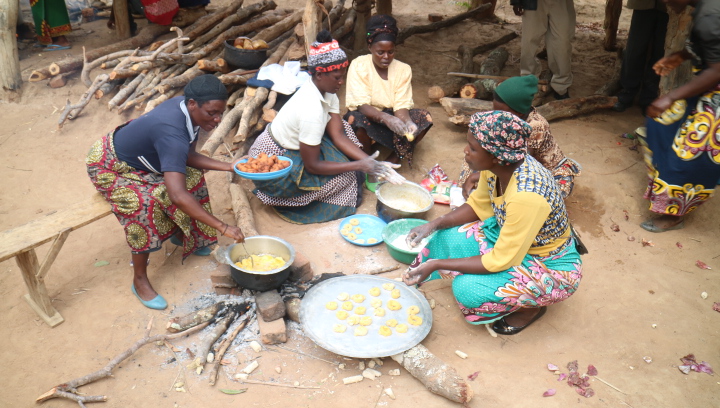
Image Caption: Loctaguna Organics Farm staff demonstrate how Bokashi compost improves soil health and enhances water retention during the KHSA Food Jam held at the farm.
Credit: Thompson Mwale